

Google DeepMind has released Gemini 4 Hydrogen, which it calls its “daily driver for agentic workflows.” Agentic workflows are jobs where a model uses tools and takes several steps on its own, as coding agents do. Google’s announcement lists availability in the Gemini API, Google AI Studio and Android Studio. It is also in Google Antigravity for paid Google AI Pro and Ultra subscribers.
One price across the full context window
The model costs $1.50 per million input tokens and $7.50 per million output tokens. Tokens are the chunks of text a model reads and writes, and they are how API usage is billed. Google says the price stays the same across the whole 1 million-token context window, so a very long prompt costs no more per token than a short one. Some other models charge a higher rate once a prompt passes a size threshold.
Four thinking levels
Hydrogen has four thinking levels: low, medium, high and xhigh. High is the default. Higher levels spend more time reasoning, which Google says trades speed and cost for quality. If your app sends many small, simple requests, a lower level is the one to try. For hard multi-step tasks, try xhigh.
Google’s benchmark results
Google reports that, compared with Gemini 3.8 Flash, Hydrogen is 2.5 times faster at the default level and scores 57% on Terminal-Bench 4.1 against 18.2%. Terminal-Bench measures how well a model completes tasks in a command-line environment. Google also says repository coding runs 2 to 2.8 times faster with 12 to 23% fewer tokens.
Google’s comparison table also includes Claude Sonnet 5.5 and GPT-6.1 Terra. Hydrogen leads on most rows, including SWE-sweep (13.5%) and Agents’ Last Exam v1.1 (71.6%). Sonnet 5.5 is ahead on Terminal-Bench 4.1 (63.9% to 57.0%) and OSWorld-2.1, a computer-use test (83.9% to 77.6%).
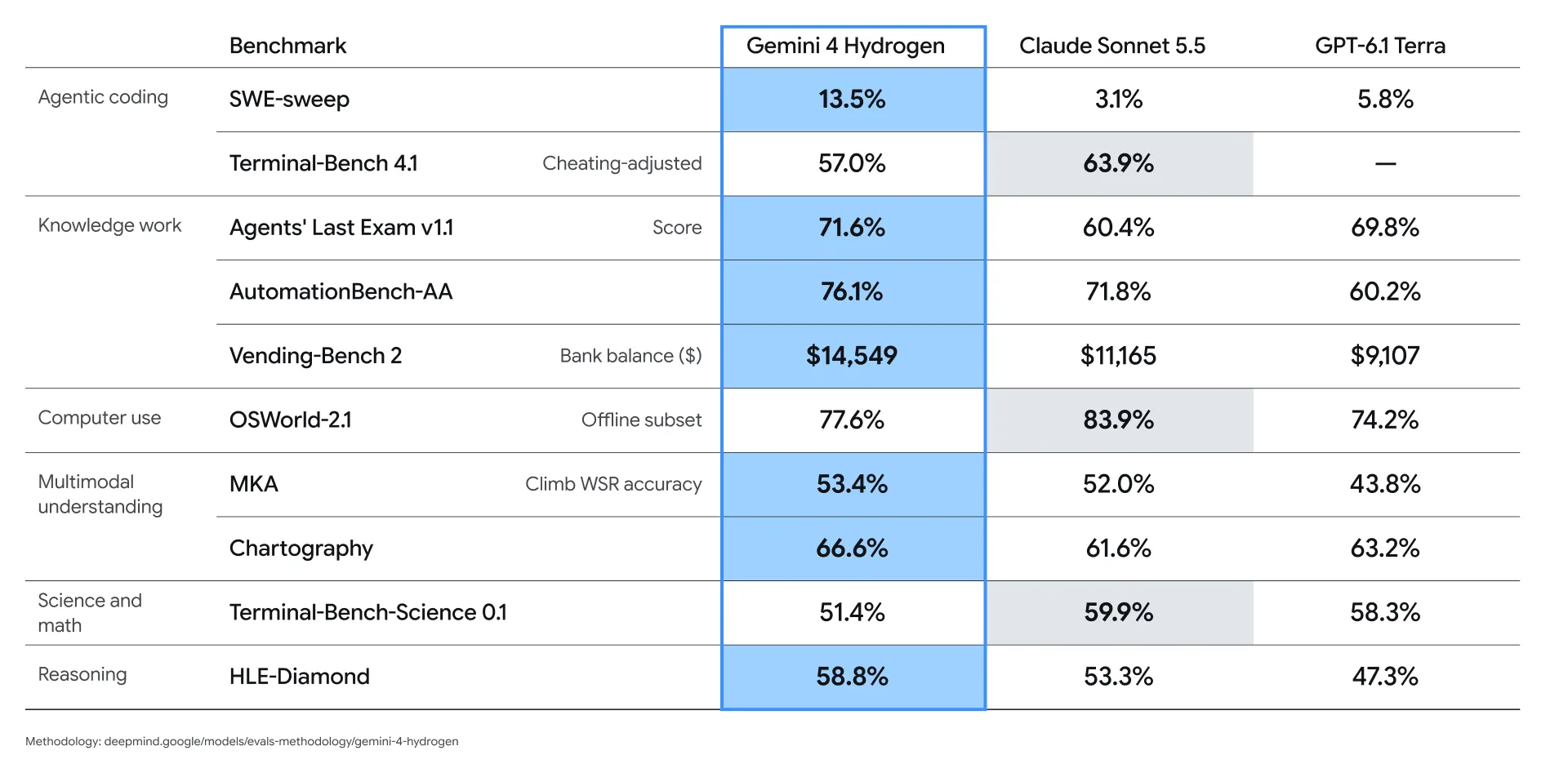
Source: Google DeepMind’s Gemini 4 Hydrogen announcement.
These are Google’s published results, and your own tasks may rank the models differently.
Safety claims for tool use
Google says Hydrogen is more than 2.3 times more resilient than competing models on the Gray Swan indirect prompt injection benchmark. Indirect prompt injection is when instructions hidden in a web page or file trick an agent into acting. Google also reports up to 81% less agentic overreach, meaning the model doing more than it was asked. These are Google’s own measurements. An agent that can run commands or touch your files still needs the permission limits you would set for any model.
End of article