

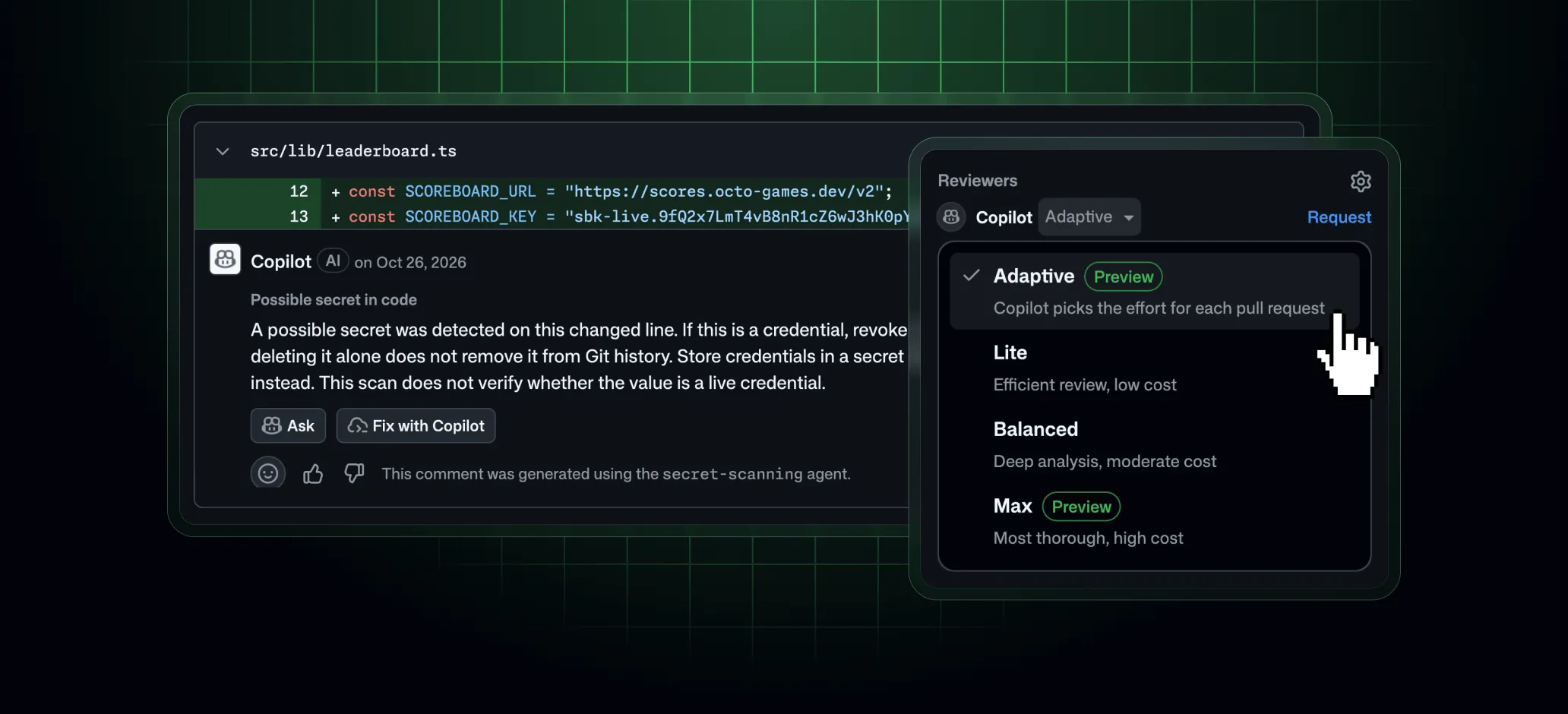
GitHub Copilot code review now flags exposed secrets in pull requests and can choose how deeply to review each one. Both are in public preview, according to GitHub’s changelog, and available on Copilot Pro, Pro+, Max, Business, and Enterprise plans. A pull request is a proposed set of changes that gets reviewed before it merges into your main code.
Secrets are flagged before they merge
A secret is a password, API key, or token that gives access to a service. Copilot now points out exposed credentials in its review comments, so you can remove them before the merge.
GitHub says detection covers more than 500 known credential formats, matched by fixed patterns built with its technical partners. For credentials with no standard format, it uses AI models. Turn it on in your repository or organization settings under Copilot > Code review.
This matters most if an agent writes much of your code. We recently covered how Claude Code’s “Don’t ask again” option can save a password into a file that ends up on GitHub. A review step that reads the diff is a second chance to catch that kind of slip. If a key does reach a pull request, still treat it as exposed and replace it, because removing it from the final diff does not erase it from the branch history.
Adaptive picks Lite, Balanced, or Max
Until now you chose a review effort level yourself. Adaptive looks at each pull request’s complexity and risk, then reviews it at Lite, Balanced, or Max, and shows which level it picked. GitHub says a documentation update may get a lighter review than a change to authentication.
Balanced stays the default. You can select Adaptive on a single pull request from the Reviewers bar, or set it as the default in personal, repository, organization, or enterprise settings. Adaptive never goes above the maximum effort level your enterprise, organization, or repository sets, so an administrator’s cap still holds.
Related repositories, for public code only
Reviews can also draw on related repositories to find external dependencies and documentation. In this preview, that works for public repositories only, so it will not pull context from your private code.
End of article