

What happened
OpenAI says Codex and ChatGPT Work have reached 9 million active users. Tibo Sottiaux, an OpenAI product leader, reported milestones from 6 million on July 12 to 9 million on July 16. OpenAI paired those announcements with banked or automatic usage resets. On July 18, Sottiaux announced another reset for paid users.
The reported count combines Codex and ChatGPT Work. It does not measure each product separately or show how often those users return.
The announcements overlapped with Anthropic’s temporary Fable 5 extensions. Anthropic has since made Fable 5 a plan benefit for Max and Team Premium users. The timing shows that usable capacity is now part of product positioning. It does not prove one vendor changed limits because of the other.
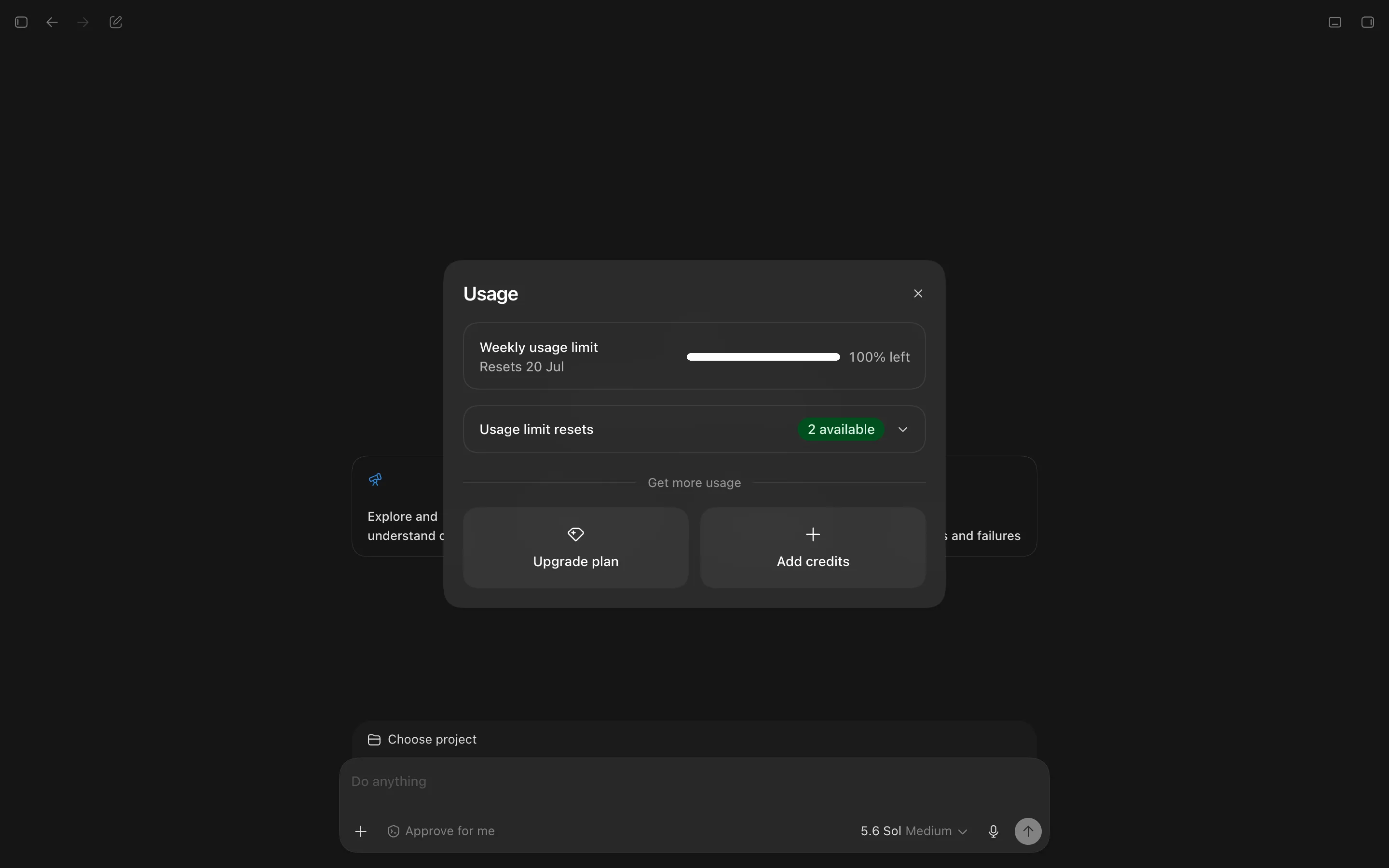
BuilderWithin checked the Codex usage panel on July 13. It showed a weekly limit resetting July 20, but no five-hour limit. Sottiaux later confirmed that the five-hour limit remained suspended.
Why it matters
OpenAI reports 9 million active users across Codex and ChatGPT Work combined. Read that as a combined adoption metric, not a count of Codex users alone.
OpenAI already reset limits and changed GPT-5.6 defaults after users encountered expensive settings and launch regressions. Anthropic had also reset Claude limits as GPT-5.6 went public.
OpenAI has now identified several causes of faster usage drain. Increasing Sol’s context window, the information it can hold during a task, from 272,000 to 372,000 tokens charged more usage than intended. Tokens are chunks of text processed by the model. OpenAI has temporarily restored the smaller window while it works on a fix.
Sottiaux also said high and extra-high reasoning settings used multi-agent work more than intended. OpenAI is reversing experiments that changed reasoning effort and adjusting its automatic review feature.
Separate changes to how efficiently the model runs should provide about 10% more Sol usage, according to Sottiaux. He also said Sol would remain included with Go, Plus, and Pro subscriptions until OpenAI ships a better model.
These changes point to a practical constraint on coding agents. Better models can run longer tasks and coordinate more work. That capability matters less when a paid allowance runs out halfway through the job.
Normal capacity and temporary capacity are different product facts. A reset can rescue this week’s work. It does not reveal how much work the same subscription will support after the reset period.
Who should care
Codex and Claude Code users should pay attention if usage limits regularly interrupt longer tasks. The changes may create room to test GPT-5.6 Sol or Fable 5 without exhausting an allowance as quickly.
Builders comparing plans should treat temporary access separately from normal value. A reset or promotional increase can improve a week of work without changing what the subscription usually includes.
Daily, weekly, and monthly adoption are different measures. Do not compare the reported nine million with those metrics without matching the reporting period.
What builders should do next
Use the expanded capacity on work that previously exhausted your allowance, such as a refactor with an existing test suite. Define which tests and behavior must pass, then track completion, corrections, elapsed time, and allowance consumed.
Do not make a subscription decision from a reset alone. Compare the normal weekly allowance after the temporary capacity has been used.
End of article